Start with the connection you need
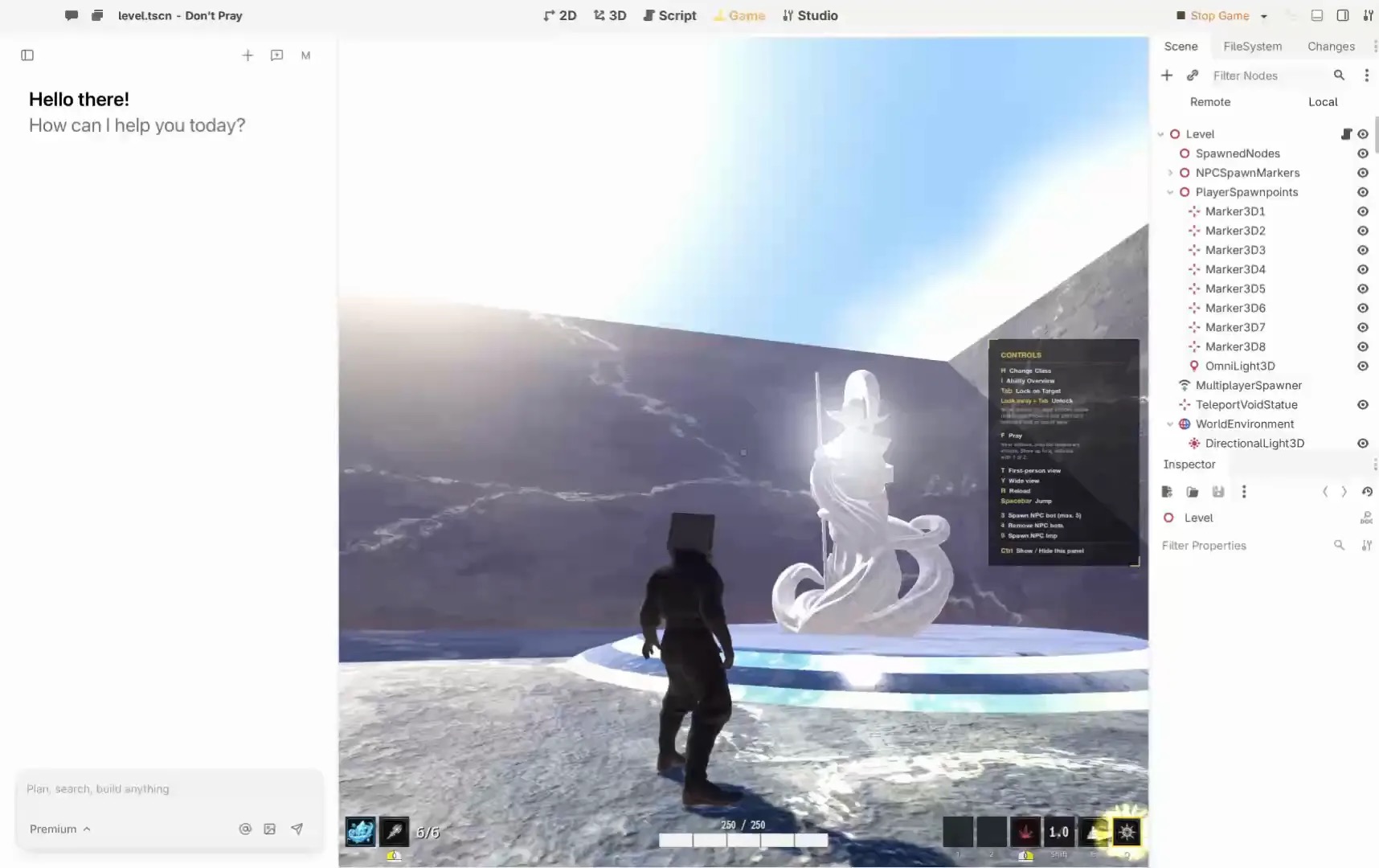
If you want an agent to work alongside you in a game editor, evaluate Summer Engine’s local setup first. Summer documents setup for Claude Code, Codex and Cursor. Its remote URL has a different scope: it covers tasks such as assets and store pages; its guide says local setup is needed to build and run games on your computer.
For a team that prioritizes an open-source engine, Godot is an MIT-licensed alternative. Treat the agent connection as a separate integration to evaluate; a coding agent’s ability to edit files does not by itself prove it can operate an editor or run a game.
Compare the complete loop
| Question | What to verify |
|---|---|
| Connection | Agent, operating system, installation and sign-in requirements. |
| Project access | Which files and projects are visible, and what changes require approval. |
| Editor feedback | Whether the agent can inspect relevant state and report errors you can reproduce. |
| Delivery | Whether the actual export runs on the intended target and can be maintained. |
Try an existing project safely
Copy a small project and ask the agent to locate a game rule before changing it. Then request one observable change, such as increasing a score target. Inspect the project, run the game and test both the old and new boundary. Close and reopen it before making the next change.
Keep your own agent’s model, subscription and usage costs separate from the engine’s price. Check plan terms and export requirements before committing. An integration may expose only a subset of an engine’s functions, even if it uses a familiar protocol.
Make the handoff repeatable
Record the engine version, project path, setup steps and a known working build. Agree on which edits need review and how to revert them. For Godot, the export documentation explains presets and platform prerequisites. Test the build outside the editor before selecting a production workflow.
A selection exercise for a small team
The following is a proposed comparison, not a benchmark result. Give each candidate the same small existing project and the same time and spending limit. The project should have a visible score, one enemy or obstacle, a restart and a target build. Record the engine version, agent, model, integration version and operating system so another teammate can repeat the exercise.
Inspect this copy of the project. Find the rule that ends the game and the code or scene that displays the score. Explain what you found without changing files. Then propose how to change the win threshold from three to five.
Check whether the answer points to the right project and whether a developer can locate the cited rule. Then authorize the change, inspect the resulting diff or scene, and play through four and five points. Close and reopen the project and repeat. If a connection can write files but cannot inspect a running editor, record that boundary rather than treating it as a failure or a feature it does not have.
Evaluate four kinds of access
Files and project structure
Can the agent read the project it is meant to change? Can a teammate understand its edits without relying on chat history? A file-editing agent may be useful even when it cannot operate the editor. In that case, plan a human editor review and runtime check as explicit steps.
Editor and runtime
Ask the provider which operations the integration exposes for the versions you use. A tool name or MCP connection does not establish scene-editing, play, screenshot or debugging parity. Test the exact task on a copy. Capture the agent response separately from the visible editor state and the game result.
Credentials and authority
Identify the account, project scope and available approvals. Start with the minimum access needed. A publishing connection can have a different authority and target from a local editor connection. Summer’s official guide describes its local setup and remote URL, and states that publishing and price changes require confirmation. Read current permissions for the actual connection; do not copy a credential into source control.
Output and ownership
Check who can open the project later, what assets are licensed for, and what the target requires. An exported executable is a delivery artifact; it may not be an editable source project. Make a teammate reopen the source from the saved checkpoint and test the exported build without the creator’s environment.
Compare costs without equating credits
List engine licensing, agent subscription or API usage, paid assets and any hosting separately. Record the plan that permits the intended collaboration and export, not just the entry price. Set a budget for the same exercise in each candidate and note the amount spent and work completed. Different credit systems and models are not directly comparable by the number of credits alone. Use current provider terms rather than projecting a monthly total from one prompt.
Make a decision record
| Requirement | Evidence to retain |
|---|---|
| Editable project | A teammate reopens the source and locates the changed rule. |
| Agent integration | Exact versions, tools available and outcome of the same requested change. |
| Target delivery | The exported artifact and observed result on the target device. |
| Commercial fit | Current plan, asset rights, team access and total estimated spend. |
When the experiment fails
If setup fails, keep the error and the version information; do not score the game quality as though the experiment ran. If the agent edits the wrong copy, revoke or narrow its access, restore from the checkpoint and confirm the project target before retrying. If the project works in the editor but not in the build, isolate export prerequisites and test the artifact. Godot’s export guide, for example, documents presets and platform-specific requirements.
Common selection questions
Does MCP guarantee compatibility?
No. MCP defines a way for applications and servers to exchange context and use tools; the available tools and permissions depend on the integration. The official architecture guide describes this division.
Should the team switch engines for an agent?
Compare the cost of migration and retraining against the specific improvement you need. Test a copy of a representative project and its release target before making the decision.
About this guide
By Summer, publisher of Agent Engine Guide. This guide uses the official sources linked above, checked November 8, 2026. The exercises are suggestions, not reported tests.
Disclosure: Agent Engine Guide is a Summer-owned marketing publication and promotes Summer products. Check providers for current capabilities and terms.